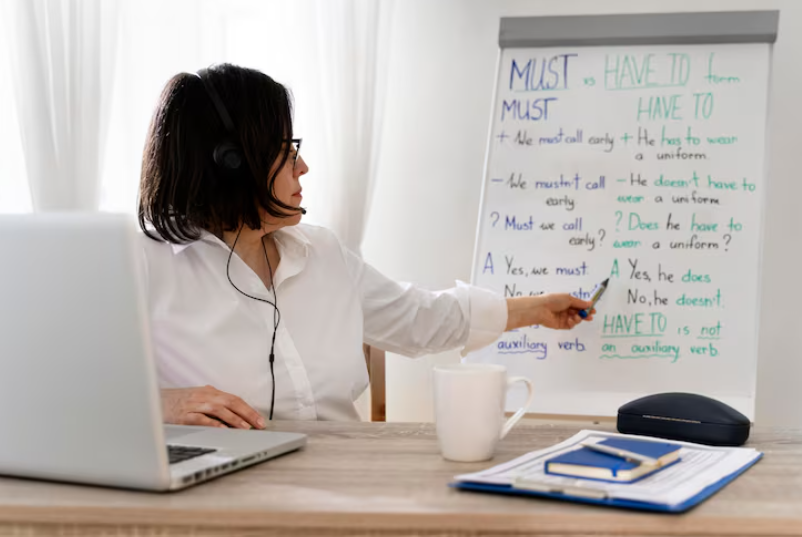
Most doctors and nurses who come to us for OET classes online aren’t short on English. They’ve been charting, presenting cases and talking to patients in English for years. The trouble is that the OET doesn’t test general English. It tests whether you can do your actual job in English, against a clock, in a format you’ve probably never seen. That gap is where scores get lost.
This guide covers what a good online OET course should include, the scores you need in 2026 (Australia changed its rules in April), how long preparation really takes, and how to choose a class without burning a test fee. The full exam costs AUD 587, so a second attempt is an expensive way to learn the format.
What the OET tests, and why it catches good clinicians out
Everything on the OET is set in a healthcare workplace. You listen to consultations, read clinical texts, write a letter from case notes and role-play a conversation with a patient. Nothing is abstract, which sounds like good news until you realise you’re marked on communication, not on how much medicine you know.
| Sub-test | Time | What you actually do |
|---|---|---|
| Listening | About 45 min | 42 questions across consultation extracts, workplace conversations and short talks |
| Reading | 60 min | 42 questions. Part A is a 15-minute scan of four short texts; Parts B and C take the remaining 45 minutes |
| Writing | 45 min | 5 minutes reading, 40 writing. One letter based on case notes |
| Speaking | About 20 min | Two role plays with an interlocutor playing the patient or carer |
Each sub-test is scored from 0 to 500. There’s no overall score and no averaging, so a 420 in Listening won’t rescue a 330 in Writing. Grade B is 350, and that’s the number most regulators care about.
Doctors and nurses sit the same test with different content
The format is identical. The material isn’t. A doctor’s Writing task is often a referral letter to a specialist or GP. A nurse is more likely to write a discharge or transfer letter to a community nurse or an aged care facility. Speaking follows the same split: a doctor might explain test results to a worried patient, while a nurse might be getting someone ready to go home after surgery. Any decent course sorts its practice material by profession from the first week.
OET scores you need in 2026
The biggest change this year came from Australia. For tests taken on or after 23 April 2026, AHPRA stopped using letter grades and started listing numeric minimums. Reading and Speaking now need 360, and Writing needs 350. Under the old rule Writing only needed a C+ (300), so if you’re planning from a blog post or video made in 2025, the Writing target in it is out of date.
| Requirement | Listening | Reading | Writing | Speaking |
|---|---|---|---|---|
| AHPRA, test taken on or before 22 April 2026 | 350 | 350 | 300 | 350 |
| AHPRA, test taken from 23 April 2026 | 350 | 360 | 350 | 360 |
| Many other regulators (check yours) | Usually 350 | Usually 350 | Usually 350 | Usually 350 |
Two things people miss. First, OET results are generally valid for two years, so sitting the test too early can backfire. Second, AHPRA’s list of accepted formats is paper or computer at a test centre. If you were planning to sit OET@Home, confirm it’s accepted for your registration before you book. Your regulator’s own website has the final word, because these rules move.
What good OET classes online should include
Online works well for the OET, as long as the course does the things a video library can’t. Here’s what to look for.
- Live speaking practice. Role plays with a trainer who marks against the OET criteria, both the language side and the clinical communication side. A study partner saying “that was fine” doesn’t count.
- Writing feedback you can act on. Your letter should come back marked against the six criteria (purpose, content, conciseness and clarity, genre and style, organisation and layout, language), with reasons. A corrected copy on its own teaches you very little.
- Timed listening and reading. Reading Part A gives you 15 minutes for 20 questions. That’s a speed skill, and it only improves under a timer.
- Mock tests on a computer. Most candidates now sit the computer-based test, and typing a letter against the clock feels different from writing one by hand.
- Profession-specific material. Real nursing or medical content, not general English worksheets with a stethoscope on the cover.
- Score tracking by sub-test. Every sub-test is scored separately, so your study plan should be too.
Red flags when comparing courses
- A guaranteed score. Nobody can promise one.
- Pre-recorded lessons only, with no live speaking or marked writing.
- Memorised letter templates. Examiners see the same stock phrases and they don’t help if your case notes differ from the sample.
- No full-length mock before you’re told to book the test.
How our OET classes online are set up at JG Language Academy
At JG Language Academy we build our OET classes online around that same checklist. Doctors and nurses work from profession-specific material, speaking practice is live, writing is marked against the criteria, and mock tests are timed. You can see how the course is laid out on our OET preparation online page.
Not sure which course fits your timeline?
Have a look at the OET preparation online course details and compare the schedule against your test date and shift pattern.
How long does OET preparation take?
| Where you’re starting | Rough prep time | What usually fills the time |
|---|---|---|
| Already scoring close to 350 in practice tests | 4 to 6 weeks | Exam technique, timing, fixing one weak sub-test |
| Around 300 to 340 in one or two sub-tests | 8 to 10 weeks | Writing structure, speaking role plays, timed Reading |
| Below 300 in several sub-tests | 12 to 16 weeks | Language base first, then exam-specific practice |
Treat those as rough guides, not promises. Your schedule matters more than most people admit. A nurse on night rotation who can protect four evenings a week often does better than someone with a free calendar who studies whenever they feel like it.
Two situations we see again and again
These are composites of common cases, not individual student stories.
The nurse who lost marks in Writing
A nurse with six years in intensive care sat her test in June 2026 and scored Listening 380, Reading 370, Speaking 360 and Writing 310. Australia needed 350 in Writing. Her letters ran long because she tried to include everything from the case notes, including history the next nurse would never need. Six weeks of practice on choosing what to leave out, and keeping letters near 180 to 200 words, fixed most of it. Worth noting: before April, that 310 would have cleared the old C+ bar. Preparing from outdated material is a quiet way to fall short.
The doctor who knew the medicine but missed the conversation
A GP with eight years of experience scored 340 in Speaking against a target of 350. He explained the diagnosis clearly and got the clinical content right. What he skipped was asking the patient what they already understood and what worried them. The Speaking criteria reward that kind of exchange, and knowing the medicine well doesn’t make up for leaving it out. A few sessions with a trainer playing an anxious patient changed how he opened every role play.
Booking your test in 2026
- Dates: computer-based tests and OET@Home run several days a week. Paper tests are held roughly every two weeks.
- Results: computer results can arrive in as little as 48 hours. Paper results take around 5 days in India and 13 days in most other regions.
- Fee: AUD 587 for all four sub-tests, or USD 455 in the USA.
- Rescheduling: roughly AUD 120 before bookings close, and around AUD 200 after that.
- Booking window: computer and OET@Home bookings close 7 days before the test date.
Our advice is to book once your mock scores hit the target more than once, not once. One good mock can be luck.
Common questions about OET classes online
Can I prepare for the OET with online classes only?
Yes. The skills can all be trained remotely. The condition is live feedback on Writing and Speaking, because those two are the hardest to judge on your own.
Do doctors and nurses need separate classes?
They need separate practice material, since the letters and role plays differ. The teaching principles, like structure, timing and patient communication, carry across.
How many hours a week should I study?
For working clinicians, 8 to 10 hours a week including practice outside class is a realistic range. More is fine if you have the time, but steady beats bursts.
What happens if I miss the target in one sub-test?
You’ll need to sit again. Whether you can retake only some sub-tests depends on the test format and your regulator, so check the OET website and your registration body before booking.
Choosing your course
Pick the class that gives you live speaking practice, marked writing and timed mocks, and tells you honestly how long you’ll need. Check your regulator’s current score table before you set a target, because 2026 changed some of them. If you’d like to see how our OET classes online are structured for doctors and nurses, start with our OET preparation online page.