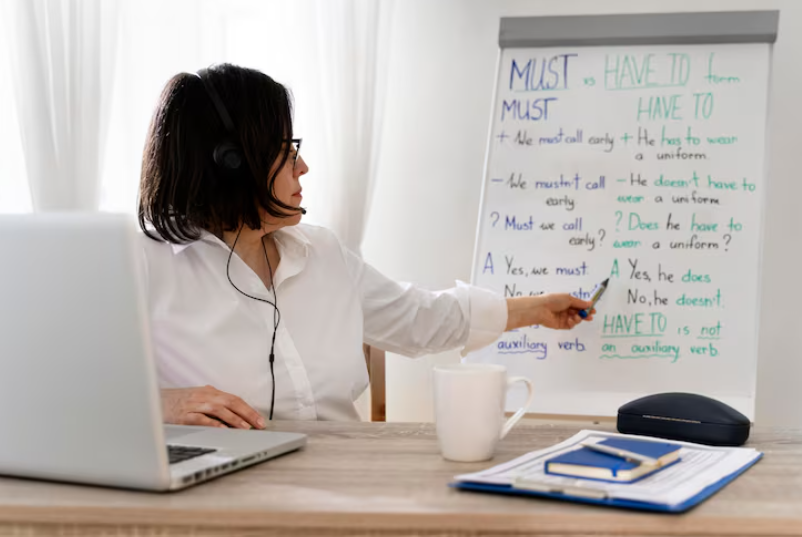

So you’ve booked your CELPIP test and now you’re staring at a blank practice sheet wondering — what on earth will they actually ask me to speak about?
That’s exactly what this guide answers.
The CELPIP Speaking section isn’t random. It follows a very defined structure — 8 tasks, specific time limits, and topic patterns that repeat in recognizable ways. Once you understand what those patterns look like in 2026, your preparation becomes a whole lot more focused (and a whole lot less stressful).
Whether you’re working with a tutor, using self-study materials, or enrolled in the best CELPIP classes online through JG Language Academy, this breakdown will give you a clear picture of what’s being asked — and how to answer it well.
How the CELPIP Speaking Section Works in 2026
Before we get into specific topics, a quick structural refresher.
The Speaking section runs approximately 15 to 20 minutes. You speak into a microphone connected to the computer — there’s no human examiner sitting across from you. Your responses are recorded and evaluated against four scoring pillars: content, vocabulary, listenability, and task fulfillment.
Here’s what 2026 has brought to this section specifically:
- A greater emphasis on Canadian cultural contexts in prompts — housing costs, workplace diversity, transit systems, community engagement
- The AI-human hybrid scoring model (introduced in late 2025) now means your responses need to satisfy both structural precision and natural delivery
- Topics have become noticeably more socially relevant — you’re likely to encounter prompts about sustainability, digital life, and everyday Canadian civic situations
One thing that hasn’t changed: the 8-task format remains exactly the same. Let’s go through each one.
Task 1 — Giving Advice (90 Seconds)
This is the opening task, and it sets the tone for your entire speaking section.
You’re shown a situation — usually involving a friend, coworker, or family member — and you’re asked to give them practical advice.
Preparation time: 30 seconds
Response time: 90 seconds
Topics That Are Showing Up in 2026
- A close friend is thinking about quitting their stable job to start a small business and isn’t sure if they should
- Your coworker feels unappreciated at work and is considering asking for a raise but doesn’t know how to approach it
- A relative recently moved to Canada and is struggling to make friends in their new neighbourhood
- A friend wants to go back to school while working full-time and is worried about the pressure
- A neighbour is trying to decide whether to buy a house now or continue renting given the current market
How to Structure Your Answer
- Acknowledge the situation with empathy — don’t just jump into advice immediately
- Give your first piece of advice with a specific, concrete reason behind it
- Give your second piece of advice — one point is never enough for a high score
- Close with genuine encouragement — something warm, not robotic
Real-World Example: If the prompt is about a friend worried about starting a business, don’t say “You should do research.” Say something like: “I’d really encourage you to spend a few weekends talking to people who’ve already started similar businesses — not just to learn from them, but to understand what the first six months actually feel like. That kind of firsthand insight is often more valuable than anything you’ll read online.”
That level of specificity is what separates a band 7 answer from a band 9.
Task 2 — Talking About a Personal Experience (60 Seconds)
Here, you’re asked to recall and describe something that happened to you. The topic is given as a prompt, and you build your response around a real (or realistic) personal memory.
Preparation time: 30 seconds
Response time: 60 seconds
Common 2026 Topics
- Describe a time you helped a stranger and how it made you feel
- Talk about a challenge you faced at work or school and how you got through it
- Describe a memorable trip you took — what made it stand out
- Talk about a time you had to learn something completely new in a short period
- Describe an event or celebration that meant a lot to you
What Makes a Strong Answer Here
The biggest mistake people make in this task is staying too surface-level. “I went to a wedding. It was nice. I had fun.” That’s not a story — that’s a caption.
A strong Task 2 answer has three clear layers:
- Scene-setting — who was there, when, where (keep it brief, about 10 seconds)
- What actually happened — the events, feelings, even a small conflict or turning point
- What you took away from it — what changed, what you learned, how you felt afterward
Verb tense accuracy matters a lot in this task. If you’re mixing up simple past and past perfect, it signals a lack of fluency to scorers. Practice switching between tenses naturally in your daily speaking exercises.
Task 3 — Describing a Scene (60 Seconds)
You’re shown an image on the screen. Your job is to describe what you see — in detail, in a structured way, and without just listing objects like a shopping receipt.
Preparation time: 30 seconds
Response time: 60 seconds
Types of Scenes Appearing in 2026 Tests
- A busy urban park with people doing different activities (cycling, playing with kids, reading on a bench)
- A community event or outdoor market
- A workplace or open-plan office setting
- A family gathering in a home environment
- A transit station or airport with people in motion
The Technique That Actually Works
Move through the image systematically — left to right, or foreground to background. Don’t jump around randomly.
More importantly, describe actions and relationships, not just objects.
- Weak: “There is a woman and a coffee cup on a table.”
- Strong: “A woman appears to be on a work call — she’s leaning slightly forward with a focused expression, and there’s an open laptop and a half-finished coffee in front of her.”
The second version gives scorers something to evaluate across vocabulary, grammar, and content simultaneously.
Task 4 — Making Predictions (60 Seconds)
Same image as Task 3. Now you predict what’s going to happen next.
Preparation time: 30 seconds
Response time: 60 seconds
This task surprises many candidates because they don’t prepare for it separately — they assume it’ll be easy since they’ve already seen the image. That’s a mistake.
What to Focus On
You need at least two or three distinct predictions, each supported by reasoning from the image itself.
- If it’s a park scene: “I think the families with young children will start heading home as it gets later in the afternoon — some of the kids look like they’re running low on energy. The older couple on the bench might stay a bit longer since they seem relaxed and unhurried.”
- If it’s an office scene: “It looks like they’re wrapping up a brainstorming session — I’d predict the team will assign tasks and schedule a follow-up meeting fairly soon.”
Vocabulary that scores well here: might, could, is likely to, will probably, it seems as though, based on what I can see.
Task 5 — Comparing and Persuading (60 Seconds)
You’re given two options and asked to convince someone to choose one over the other.
Preparation time: 30 seconds
Response time: 60 seconds
2026 Topic Patterns
- Convince a friend to take a road trip across provinces rather than flying
- Persuade a coworker to choose a restaurant for a team lunch — you’re comparing two places with different styles
- Convince a family member that joining a local gym is better than setting up a home workout space
- Persuade someone to attend an in-person event rather than watching it online
- Convince a friend to try cooking a meal at home rather than ordering in
The Structure That Wins Marks
- Briefly acknowledge both sides — don’t pretend one option has zero merit
- Make your case clearly — lead with your strongest reason first
- Explain why the alternative falls short in at least one specific way
- Close with a recommendation that sounds natural, not like a script
Case Study — What a 9-Level Answer Looks Like: A student at JG Language Academy was practicing a “beach vs. mountains” prompt. Her initial answer listed three general benefits of the beach. After coaching, her revised answer opened with: “I know the mountains are tempting — and I get it, the hiking is incredible — but for what you’re describing, I really think the beach is the better call this time.” That opening immediately showed persuasive tone, acknowledged the alternative, and set up her reasons naturally. Her score jumped from band 7 to band 9 on that task.
Task 6 — Dealing with a Difficult Situation (60 Seconds)
You’re placed in a scenario where something has gone wrong — a service failure, a billing error, a promise that wasn’t kept — and you need to address it calmly and effectively.
Preparation time: 30 seconds
Response time: 60 seconds
Scenarios Showing Up in 2026
- You ordered a product online and it arrived damaged — you’re calling customer service
- A hotel gave your reserved room to someone else and you need a resolution
- A contractor finished a job poorly and you need to address it without escalating
- You were billed incorrectly for a service subscription you cancelled
- A landlord hasn’t responded to a maintenance issue you flagged weeks ago
The Balance This Task Tests
You’re not being asked to blow up at someone. You’re being assessed on whether you can be firm, specific, and professional — all at once.
Structure your response like this:
- State the problem clearly (what happened, when)
- Describe the impact it’s had on you
- Ask for a specific resolution — not just “fix it” but how you want it fixed
- Use language that’s assertive without being aggressive
Phrases that work well here: “I’d really appreciate if we could resolve this today,” “I’m hoping we can find a fair solution,” “What I’m looking for is…”
Task 7 — Expressing Opinions (90 Seconds)
This is the longest response task in the section. You’re given a debatable topic and asked to share your view, support it with reasons, and demonstrate that you can think critically about both sides.
Preparation time: 30 seconds
Response time: 90 seconds
Hot Topics Appearing in 2026
- Should all public transit in major Canadian cities be made free for residents?
- Is remote work better for overall employee wellbeing, or does it create more problems than it solves?
- Should smartphones be banned in schools up to grade 8?
- Do social media platforms have a responsibility to regulate what users post?
- Should university tuition in Canada be fully government-funded?
- Is it better for children to grow up in a big city or a smaller town?
Why This Task Trips People Up
Many candidates either:
- Pick a side and hammer it repeatedly without real supporting reasons, or
- Try to be so balanced they never actually commit to a clear position
Neither approach scores well.
A strong Task 7 answer commits to a position early, builds it with two or three layered reasons (not just opinions but reasoning), briefly acknowledges the opposing view, and wraps up by restating the position in a slightly different way.
Example Opening That Works: “Personally, I think banning phones in schools below grade 9 is a reasonable step — not because phones are inherently harmful, but because the research on attention spans and classroom focus is hard to ignore at that age.”
That single sentence does three things: states a position, shows nuance (“not because… but because”), and grounds the opinion in something beyond personal preference.
Task 8 — Describing an Unusual Situation (60 Seconds)
The final task shows you an image with something unexpected or out of place — and you describe what you think is happening, why it might be happening, and how the people in the image might be feeling.
Preparation time: 30 seconds
Response time: 60 seconds
Common Scenarios in 2026
- Someone in formal business attire doing an outdoor physical activity
- A large crowd gathered somewhere that seems unexpected (a parking lot, a rooftop)
- An animal doing something comical or unusually human-like
- A person reacting with strong surprise to something just out of frame
- An everyday location with one element that clearly doesn’t belong
How to Handle the Unexpected
Don’t panic just because the image is strange. That’s the point — the task wants you to think on your feet and speak about ambiguity.
Structure your answer around three questions:
- What is clearly happening in the image?
- Why might this be happening? (Your interpretation — you can have fun with this)
- How do you think the people/subjects feel about it?
The unusual element isn’t a trick — it’s an invitation to show vocabulary, speculation language, and natural conversational confidence.
CELPIP Speaking: Quick Reference Table for 2026
| Task | What You’re Asked to Do | Prep Time | Response Time |
|---|---|---|---|
| Task 1 | Give advice on a situation | 30 sec | 90 sec |
| Task 2 | Describe a personal experience | 30 sec | 60 sec |
| Task 3 | Describe a scene (image) | 30 sec | 60 sec |
| Task 4 | Predict what happens next (same image) | 30 sec | 60 sec |
| Task 5 | Compare two options and persuade | 30 sec | 60 sec |
| Task 6 | Handle a difficult situation | 30 sec | 60 sec |
| Task 7 | Express your opinion on a topic | 30 sec | 90 sec |
| Task 8 | Describe an unusual image/scene | 30 sec | 60 sec |
The 4 Scoring Criteria — What Raters Actually Look For
Your speaking responses are evaluated on four dimensions:
1. Content Did you answer what was actually asked? Did you stay on topic and cover enough ground without going off on tangents?
2. Vocabulary Are you using a range of words and phrases, or repeating the same five expressions throughout? Are your word choices precise and appropriate for the context?
3. Listenability Can the listener follow you without effort? This includes clarity of pronunciation, natural pacing (roughly 130–150 words per minute is the sweet spot), and minimal disruptive filler sounds.
4. Task Fulfillment Did you complete what the task asked — all of it? For advice tasks, did you give two pieces of advice? For opinion tasks, did you address the opposing view?
Knowing these four pillars helps you self-evaluate during practice. After recording your response, ask yourself: Did I check all four boxes?
3 Mistakes That Cost Candidates Real Marks
Memorizing Full Scripts
Test-takers who try to memorize full responses sound robotic. The CELPIP AI scoring system in 2026 is specifically trained to flag unnatural delivery. Worse, memorized answers often don’t quite match the actual prompt, so you end up losing marks on task fulfillment.
What to do instead: memorize structures, not scripts. Know your three-point framework for Task 7. Know your opening line formula for Task 6. Fill in the content on the fly.
Speaking Too Fast Under Pressure
Many candidates rush because they’re nervous and want to fit everything in. But speaking too fast tanks your listenability score and makes filler words more noticeable.
Aim for a natural, conversational pace. If you practice with a timer, don’t try to cram everything in — practice finishing each task in a complete, unhurried way.
Ignoring the Canadian Context
The 2026 topic bank is noticeably more Canadian in its framing. Questions about housing affordability, neighbourhood community life, public healthcare, and transit all come up regularly. If you’re not familiar with these contexts, your answers can sound generic.
Spend time reading Canadian news, listening to CBC Radio podcasts, and discussing these topics in your prep sessions. The best CELPIP classes online through JG Language Academy incorporate exactly this kind of context-building into their curriculum — not just grammar drills, but real Canadian conversational practice.
How JG Language Academy Approaches CELPIP Speaking Prep
At JG Language Academy, CELPIP speaking preparation is built around one philosophy: candidates learn more from doing and getting feedback than from watching or reading alone.
The online program includes:
- Timed task simulations — responses recorded and reviewed in the exact format of the real test
- Task-specific coaching — you don’t practice all 8 tasks the same way; each one gets its own strategy
- Canadian context modules — sessions that familiarise you with the cultural topics that are showing up in 2026 prompts
- Weekly mock speaking tests — full 8-task simulations with detailed feedback on all four scoring criteria
- One-on-one feedback sessions — for candidates who want targeted help on specific tasks or recurring errors
The goal isn’t to get you to “pass” — it’s to get you to the CLB level that actually opens the right doors for your Express Entry or PR application.
How to Practice at Home Between Sessions
Even when you’re not in a class, speaking practice can happen every day with the right approach.
Daily habits that move the needle:
- Pick one CELPIP speaking task type each day and record a full response on your phone
- Listen back critically — are you pausing in the right places? Are you using transition phrases?
- Practice Task 7 opinion responses on topics you read about in the news that morning
- Do a 30-second prep drill: pick a topic, spend exactly 30 seconds making notes, then speak for 60 seconds
- Record yourself speaking for 5 minutes straight on any topic — this builds fluency more than short bursts
One thing many candidates underestimate: the 30-second prep time is genuinely useful if you know how to use it. In those 30 seconds, write down two or three key words as anchors — not full sentences, just triggers. That prevents you from going blank when you start speaking.
Final Thoughts
The CELPIP Speaking section in 2026 is structured, predictable, and very much learnable. The 8 tasks don’t change. The topic categories are recognisable. The scoring criteria are transparent. What separates high scorers from average scorers isn’t talent — it’s structured preparation and consistent practice.
Know your task formats. Build your vocabulary around Canadian everyday contexts. Practice giving specific, reasoned responses rather than vague general ones. And wherever possible, get real feedback on your recordings.
If you want a structured program that takes you through all of this step by step, the best CELPIP classes online at JG Language Academy are built to do exactly that — with expert instructors, regular mock tests, and a curriculum that reflects what’s actually on the 2026 test.
Your target score is achievable. Start with the tasks you find hardest, build from there, and treat every practice session as a real test opportunity.
JG Language Academy offers CELPIP preparation online for Canada PR applicants. Visit jglanguageacademy.com to explore current course offerings and batch schedules.